

The Rise of Accountability in SEO
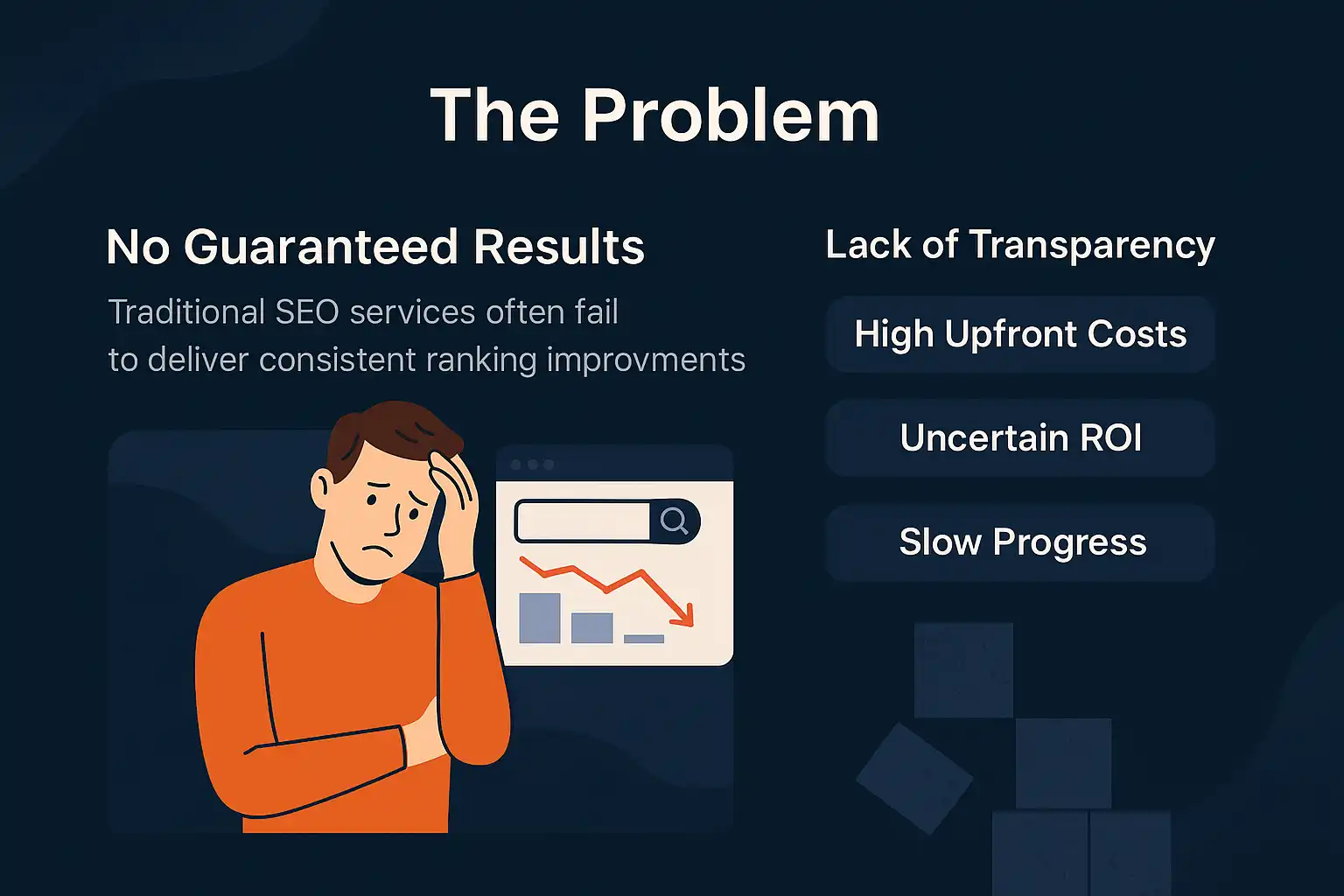
For more than a decade, SEO agencies have relied on monthly retainers.
Clients paid fixed fees — often without knowing what actually happened behind the scenes.
Reports came filled with numbers: impressions, backlinks, traffic growth.
But the one metric that truly matters — ROI — remained a mystery.
That’s exactly where performance-based SEO enters the picture.
This new model shifts the focus from activity to results, from spending to earning, and from guessing to data-driven execution.
What Exactly Is Performance-Based SEO?
Performance-based SEO, also known as pay-for-performance SEO, is a results-oriented approach where payment depends on measurable outcomes.
That could include higher keyword rankings, increased organic traffic, or verified conversions.
Instead of charging monthly retainers, agencies and consultants get paid only when agreed-upon KPIs are met.
It’s a model built on fairness and accountability — where both sides share the risk, and both benefit from growth.
In short: If you don’t rank, you don’t pay.
The concept isn’t entirely new — but in 2025, it’s becoming mainstream thanks to data analytics, real-time tracking, and clearer ROI measurement tools.
How Performance-Based SEO Differs from Traditional SEO
Traditional SEO models focus on input-based billing:
time spent, hours logged, deliverables completed.
Performance-based SEO focuses on output — what’s actually achieved.
| Traditional SEO | Performance-Based SEO |
|---|---|
| Monthly retainers | Pay for measurable results |
| Limited accountability | Transparent metrics and dashboards |
| Client carries full risk | Shared risk and reward |
| Focus on activity | Focus on ROI |
| Unclear timeframes | Data-driven timelines |
This shift doesn’t just benefit clients — it also pushes agencies to become more efficient, strategic, and transparent.
Why Good SEO Still Takes Time
One misconception about performance-based SEO is that it promises instant results.
In reality, good SEO takes time — regardless of the model.
What changes is how time is invested.
Instead of producing content for the sake of output, data-driven SEO campaigns use precise analysis to determine what truly moves the needle.
That means:
Fewer unnecessary blog posts
Smarter keyword targeting
Cleaner technical SEO
Faster ROI visibility
Performance models simply ensure that time is aligned with measurable growth — not invoices.
The Data-Driven Nature of Performance SEO
At the heart of every performance-based SEO campaign lies data.
Data-driven SEO allows for:
Identifying profitable keywords through search intent analysis
Monitoring ranking velocity to adjust strategies quickly
Tracking leads, not just sessions
Linking revenue directly to organic growth
Tools like Google Search Console, GA4, and advanced rank trackers make it possible to track ROI in real time — something that was nearly impossible in older SEO frameworks.
This transparency is what gives performance-based SEO its edge: decisions backed by evidence, not assumptions.
The Core Elements of a Performance-Based SEO Campaign
Every effective campaign combines several strategic pillars:
Market & SEO Potential Analysis
Before any optimization begins, the market is analyzed for demand, competitiveness, and potential ROI. Not every industry benefits equally from SEO — and that’s exactly why validation is crucial.Technical SEO Audit
A comprehensive check of website structure, crawlability, page speed, schema, and mobile usability. Performance-based strategies can’t succeed on weak foundations.On-Page Optimization & Content Strategy
Data-driven content creation replaces keyword stuffing. Each page is built around user intent and measurable conversion goals.Off-Page SEO & Authority Building
High-quality backlinks, local citations, and digital PR establish domain trust and relevance — essential for long-term performance.Conversion Optimization & Tracking
Because rankings mean little without conversions, funnel optimization and analytics setup are integral parts of every campaign.Performance Review & Transparent Reporting
Real-time dashboards visualize rankings, traffic, and lead metrics — ensuring both parties stay accountable.
Why More Businesses Are Switching to Performance-Based SEO
The shift isn’t just about saving money — it’s about fairness.
Here’s why companies across industries are moving toward result-based models:
Shared accountability: Agencies profit only when the client does.
Faster feedback loops: Clear data allows for quick optimization.
Reduced financial risk: No payment without results.
Better resource allocation: Budgets go to what actually works.
Performance-based SEO aligns both sides with the same outcome: growth that can be measured.
Challenges of Performance-Based SEO
While the model sounds ideal, it’s not without challenges.
Not every niche or project qualifies.
Highly seasonal businesses, startups with no data, or low-margin industries may lack the baseline needed to measure results effectively.
That’s why credible agencies start with a market validation phase — a detailed analysis to see whether SEO can be profitable before anyone commits.
When It Works Best
Performance-based SEO thrives when:
The business already has search demand.
Conversion paths are measurable (calls, forms, bookings, purchases).
The client understands SEO as a long-term investment.
There’s mutual transparency and data access.
Local businesses, service providers, and e-commerce brands tend to benefit the most — because results can be directly tied to sales.
Case in Point: Local Business SEO Performance
In local markets, where rankings directly impact phone calls and walk-ins, performance-based SEO can outperform any ad spend.
Imagine a physiotherapy clinic ranking top 3 for “physiotherapie hausbesuche berlin” —
every new patient comes from organic visibility, and the clinic pays only for that verified growth.
That’s the future of ROI-driven marketing: risk-free, data-based, and client-centric.
Learn More About Performance-Based SEO
If you want to understand how performance-based SEO works in practice — from risk-sharing models to measurable ROI tracking — several specialized agencies have adopted this approach as their core service model.
One example is Performance-Based SEO, which focuses on verifiable results, transparent data, and long-term growth partnerships.
Their model illustrates how the concept can be applied across local businesses, e-commerce, and B2B sectors — shifting SEO from retainer-based work to performance accountability.
Conclusion: The Future of SEO Is Performance-Based
The SEO industry is evolving.
As tracking tools become more precise and ROI easier to prove, accountability becomes the new standard.
Performance-based SEO isn’t just another trend — it’s a shift toward measurable, honest, and data-backed growth.
Agencies that embrace transparency will thrive.
Clients who demand accountability will save money — and finally see where it goes.
Because in the end, the best SEO isn’t about rankings.
It’s about results you can measure — and pay for only when they’re real.